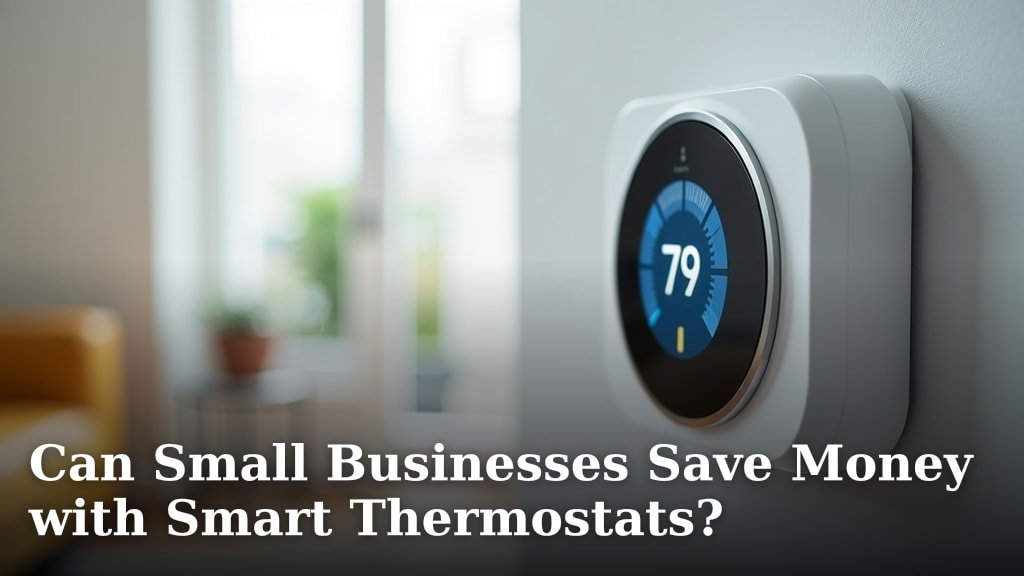
Yes, small businesses can absolutely save money with smart thermostats. These devices optimize your heating and cooling based on actual usage patterns. This means you avoid wasting energy when your business is closed, leading to noticeable cost reductions on your utility bills. Smart thermostats offer a straightforward way to cut down on energy expenses.
Beyond just saving cash, smart thermostats provide enhanced control and data. You can often monitor energy use remotely from your smartphone or computer. This allows for quick adjustments and a better understanding of your consumption. Many business owners find this level of insight incredibly helpful for managing overhead and making informed decisions about energy efficiency.
TL;DR:
- Smart thermostats help small businesses save money.
- They reduce energy waste by learning schedules.
- Remote control and energy usage data are key benefits.
- Installation is often simple and cost-effective.
Let’s walk through exactly how smart thermostats can benefit your business and cut down those energy bills.
Cutting Utility Costs for Your Small Business with Smart Thermostats
You might be wondering if a smart thermostat is really worth it for your small business. The short answer is a resounding yes. These devices are designed to be smarter than your old-fashioned programmable thermostat. They learn your business’s routine. This means they can automatically adjust your heating and cooling. You won’t be paying to heat or cool an empty building. This leads to direct savings on your energy bills.
How Smart Thermostats Learn Your Business’s Rhythm
Unlike older models, smart thermostats don’t just follow a set schedule you input. They often use sensors and even geofencing to understand when your business is occupied. Geofencing uses your smartphone’s location. When your phone leaves a certain radius around your business, the thermostat can adjust to an energy-saving mode. When you or your employees are about to arrive, it can start warming or cooling the space.
Many smart thermostats also learn from your manual adjustments. If you consistently turn down the heat at 5 PM, the thermostat will eventually start doing it automatically. This adaptive learning is key to their efficiency. They become tailored to your specific business operations. This avoids the common pitfall of forgetting to change the thermostat settings before leaving for the day.
Direct Savings: Less Energy Used, More Money Kept
The most compelling reason to consider a smart thermostat is the potential for significant cost reduction. Energy expenses can be a substantial overhead for small businesses. By reducing unnecessary heating and cooling, you’re directly cutting down on that expense.
We found that businesses that implement smart thermostats often see a reduction of 10-20% on their heating and cooling bills. This isn’t just wishful thinking; it’s the result of minimized energy waste. Think about your average energy bill. A 15% saving on that amount can add up quickly over a year. That’s money you can reinvest in your business.
Understanding Energy Waste in Business Settings
Many small businesses operate on a schedule that isn’t the same every day. You might have early mornings, late nights, or weekends where the building is largely unoccupied. Traditional thermostats often continue running at programmed settings, even if no one is there to benefit. This is where the waste happens.
Consider a retail shop that closes at 6 PM but is programmed to stay at a comfortable 72 degrees until 10 PM. That’s four hours of unnecessary energy consumption. A smart thermostat can detect this lack of activity and lower the temperature significantly. This prevents wasted energy without sacrificing comfort when needed.
Remote Control: The Power in Your Pocket
One of the standout features of smart thermostats is their remote control capability. Most models connect to your home Wi-Fi. This allows you to control them from a smartphone app, tablet, or computer, no matter where you are. This offers unparalleled flexibility and control.
Imagine you’re heading back to the office after a weekend. You can turn on the HVAC system from your phone on the drive in. Your building will be at the perfect temperature by the time you arrive. This prevents a sudden surge in energy use as the system tries to catch up. It also means you can react to unexpected changes.
Addressing Unexpected Business Needs
What happens if a supplier arrives early and needs access to your building on a holiday? Or if an employee needs to work late unexpectedly? With a smart thermostat, you can easily adjust the temperature remotely. You can ensure comfort for those who are present without heating or cooling the entire space unnecessarily for long periods.
This level of control also helps in situations where you might forget to adjust settings. If you leave in a rush, you can quickly pull up the app and set the thermostat to an energy-saving mode. It’s a simple way to ensure efficiency even on your busiest days.
Data and Insights for Smarter Decisions
Smart thermostats do more than just control temperature; they provide valuable data about your energy usage. Most apps offer reports and historical data. You can see how much energy your HVAC system is consuming over time. You can also see how different temperature settings impact that usage.
This information is gold for any small business owner looking to manage overhead. You can identify patterns and trends. Perhaps you notice higher energy use on certain days or during specific hours. This data can help you make informed decisions about your business operations. You might find ways to optimize scheduling or insulation.
Identifying Energy Inefficiencies
By reviewing your energy reports, you might uncover inefficiencies you weren’t aware of. For example, if your system runs constantly even at moderate outdoor temperatures, it could indicate an insulation problem or a poorly maintained HVAC unit. The smart thermostat data can act as an early warning system.
We found that this data helps business owners become more aware of their energy footprint. This awareness is the first step toward making meaningful changes. It helps you quantify the impact of any energy-saving measures you implement. You can track your progress and see the financial benefits directly.
Installation and Initial Costs: Is It Worth It?
Many small business owners hesitate due to the perceived cost of installation. However, the market offers a range of smart thermostats at various price points. Some basic models are surprisingly affordable. Professional installation might add to the cost, but many smart thermostats are designed for DIY installation.
The installation process is often straightforward. You typically replace your existing thermostat with the new smart unit. If you’re comfortable with basic wiring, you can likely do it yourself. Many manufacturers provide detailed guides and video tutorials to help you through the process. If you’re not confident, a qualified HVAC technician can usually install it quickly.
Calculating Your Return on Investment (ROI)
To see if a smart thermostat makes financial sense for your business, consider a simple ROI calculation. Estimate your current annual heating and cooling costs. Then, estimate the potential savings from a smart thermostat (e.g., 15%). Finally, subtract the cost of the thermostat and any installation fees from your estimated annual savings.
For instance, if your annual HVAC bill is $3,000 and you estimate savings of 15% ($450 per year), and the thermostat costs $200, you could see a return on your investment in less than six months. This makes smart thermostats a financially sound investment for most small businesses.
A Smart Thermostat Checklist for Your Business
To help you decide if a smart thermostat is the right fit for your business, consider these points:
- Does your business have a predictable occupancy schedule?
- Are you looking for ways to reduce your monthly utility bills?
- Do you want more control over your building’s temperature when you’re away?
- Are you interested in understanding your energy usage patterns better?
- Is your current thermostat old or lacking programmable features?
- Do you have a Wi-Fi connection in your business space?
If you answered yes to most of these questions, a smart thermostat is likely a worthwhile upgrade. It’s a practical step towards greater energy efficiency and cost savings for your business. Think of it as a small investment that pays you back over time through reduced operating expenses.

Conclusion
You’ve seen that smart thermostats offer a clear path for your small business to cut down on energy expenses. They intelligently manage your heating and cooling, preventing waste when your business is empty. This smart control translates directly into lower utility bills, freeing up cash for other priorities. Plus, the ability to monitor and adjust settings remotely gives you peace of mind and flexibility. Considering the potential savings and ease of use, upgrading to a smart thermostat is a practical, financially sound decision for your business’s bottom line. Why not start researching models that fit your business needs today? Consider if a smart thermostat is worth it for your business’s bottom line.
Frequently Asked Questions
How much money can a small business typically save with a smart thermostat?
Research and findings suggest that small businesses can often see heating and cooling bill reductions of 10-20% by using smart thermostats. This saving directly impacts your overhead costs. The exact amount depends on your business’s size, usage patterns, and local energy rates.
Are smart thermostats difficult to install in a commercial space?
Many smart thermostats are designed for DIY installation, similar to their predecessors. If you’re comfortable with basic wiring, you can likely install it yourself with provided guides. For most businesses, professional installation by an HVAC technician is quick and straightforward if needed.
Can a smart thermostat help if my business has irregular hours?
Absolutely. Smart thermostats excel with irregular schedules because they learn your actual usage or use geofencing based on your smartphone’s location. This means they won’t waste energy heating or cooling when no one is present, regardless of a fixed schedule.
What kind of data do smart thermostats provide for businesses?
Most smart thermostats come with apps that offer reports on your energy consumption. You can view historical data, see how temperature changes affect usage, and identify periods of high energy draw. This information helps you understand your business’s energy footprint better.
Do I need a strong Wi-Fi signal for a smart thermostat to work?
Yes, a stable Wi-Fi connection is necessary for a smart thermostat to function fully. This connection allows for remote control via smartphone apps, firmware updates, and access to energy usage data. Ensure your business has reliable internet service before installation.
