
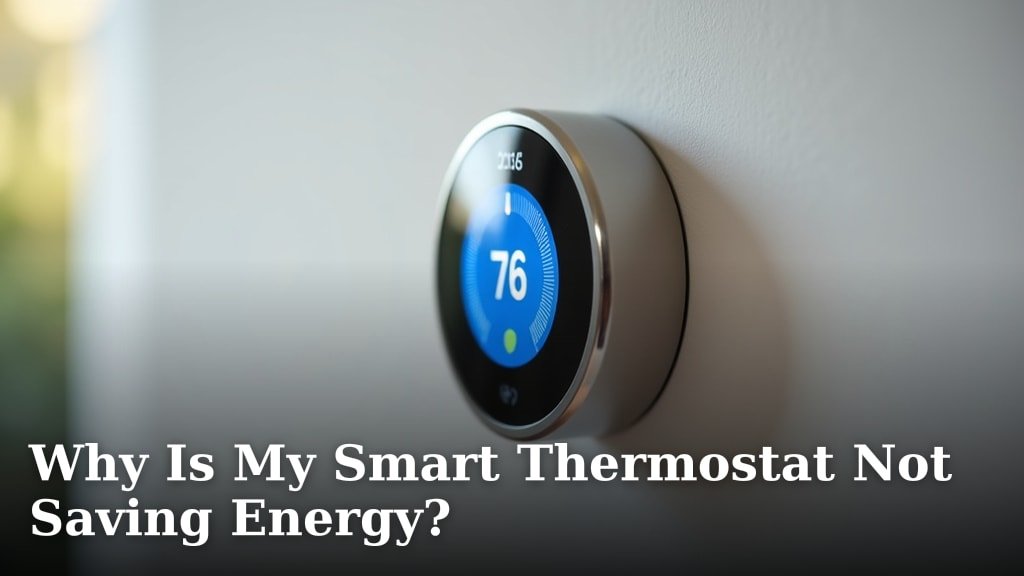
Your smart thermostat might not be saving energy because of incorrect settings, poor insulation, or even old HVAC equipment. Many people assume these devices are magic, but they need a little help to work best. To understand the potential benefits, our guide on “Do Smart Thermostats Really Save Energy” provides a comprehensive overview of their capabilities.
You might have expected instant savings, right? We found that often, smart thermostats don’t save energy if they aren’t programmed correctly or if your home has other energy efficiency issues. It’s not always the thermostat’s fault!
- Your settings might be wrong.
- Home insulation could be bad.
- HVAC system might be old.
- Geofencing may not be active.
- You might be overriding schedules.
Let’s dive into why your smart thermostat isn’t saving energy and what steps you can take to fix it. We’ll help you get those energy bills down!
Understanding Why Your Smart Thermostat Isn’t Delivering on Energy Savings
You bought a smart thermostat for a reason, right? To save energy and lower your bills. So, what happens when it doesn’t? Let’s explore the common culprits.
We found that often, the issue isn’t the device itself. It’s usually a combination of settings, your home’s energy efficiency, or even simple user error.
Incorrect Programming and Settings
Think of your smart thermostat like a super-smart pet. It’s brilliant, but it still needs you to teach it the rules. Incorrect settings are a primary reason you might not see savings.
Ignoring or Overriding Schedules
Many people set up a schedule once and then forget about it. Or worse, they constantly override it. Does this sound familiar?
Your thermostat learns your habits. But if you’re always changing the temperature manually, you’re essentially telling it, “Hey, forget what I told you!” This can lead to wasted energy as it struggles to predict your needs.
We found that consistent scheduling is key. Let the thermostat do its job.
Conflicting Features and Settings
Smart thermostats come with many cool features. Things like “eco mode,” “away mode,” and “geofencing.” But sometimes, these features can clash.
For example, if your geofencing is on, but you also have a strict schedule, they might fight. The thermostat doesn’t know which command to prioritize. This leads to inefficient operation.
Review all your settings to make sure they’re working together, not against each other.
Temperature Setback Misconceptions
You might think setting your thermostat really low in summer or really high in winter will cool or heat your home faster. This isn’t true. It just makes your system work harder and longer.
Your HVAC system operates at a set speed. It will still take the same amount of time to reach your desired temperature. All you’re doing is wasting energy by pushing it too far (Energy.gov).
Aim for a reasonable, comfortable temperature. Keep your desired range small.
Home Efficiency Issues
Your smart thermostat can only do so much. If your home is like a leaky bucket, no amount of smart technology will stop the water from escaping. Let’s look at what might be affecting your home’s efficiency.
Poor Insulation and Air Leaks
Is your home properly insulated? We found that poor insulation is a huge culprit for high energy bills. Heat escapes in winter. Cool air escapes in summer.
Check for drafts around windows and doors. Look at your attic insulation. These are common spots where your conditioned air is literally flying out the window.
- Drafty windows and doors.
- Insufficient attic insulation.
- Cracks in walls or foundations.
- Unsealed electrical outlets.
Sealing these leaks can make a big difference. It helps your smart thermostat work more efficiently.
Old or Inefficient HVAC System
Even the smartest thermostat can’t magically upgrade an old, struggling HVAC system. Is your furnace or AC unit past its prime?
Older systems are often less efficient. They have to work harder to achieve the same results. This means higher energy consumption, regardless of your thermostat’s smart features.
Consider regular maintenance for your HVAC. Sometimes, an older unit might need replacement for true energy savings.
Ductwork Problems
Your ducts are like the highways for your conditioned air. If those highways have potholes or detours, your air won’t get where it needs to go efficiently.
Leaky ductwork can lose a significant amount of heated or cooled air before it even reaches your rooms. This means your system runs longer to compensate.
Have your ducts inspected for leaks or blockages. Sealing them can greatly improve efficiency.
User Habits and Expectations
Sometimes, the problem isn’t the device or the house. It’s us! Our habits play a big role in energy consumption.
Overriding Smart Features
You bought a smart thermostat for its smarts, right? But are you letting it be smart?
Many smart thermostats have “learning” capabilities. They learn your preferences and optimize for them. If you constantly override its suggestions, it can’t learn. You’re essentially turning a smart device into a basic one.
Try to trust your thermostat’s programming. Give it time to learn your home’s rhythm.
Unrealistic Expectations for Savings
It’s easy to believe a smart thermostat will slash your bills by 50% overnight. While they can offer significant savings, they aren’t miracle workers.
Energy savings vary greatly depending on your climate, home efficiency, and personal habits. We found that a 10-15% saving is a more realistic expectation for most homes (EPA).
Think of it as a tool to help manage energy, not a magic wand.
Troubleshooting Your Smart Thermostat: A Checklist
Feeling overwhelmed? Here’s a quick checklist to help you pinpoint why your smart thermostat isn’t saving energy.
| Issue Category | Potential Problem | What to Check |
|---|---|---|
| Thermostat Settings | Incorrect Scheduling | Are your daily and weekly schedules set correctly and consistently? |
| Conflicting Features | Are geofencing, eco-mode, and schedules working together, or fighting? | |
| Home Efficiency | Poor Insulation/Drafts | Check windows, doors, and attic for air leaks. |
| Old HVAC System | When was your furnace/AC last serviced or replaced? | |
| Ductwork Leaks | Have your ducts been inspected for efficiency? | |
| User Habits | Manual Overrides | Are you frequently changing the temperature manually? |
By going through this table, you can start to identify specific areas to focus on.
Maintenance and Sensor Issues
Sometimes, the problem is simpler than you think. A little maintenance can go a long way.
Dirty Air Filters
This is a big one! A dirty air filter restricts airflow. Your HVAC system has to work much harder to push air through. This means more energy use and less efficient heating or cooling.
Check your air filter monthly. Replace it every 1-3 months, depending on your home and pets.
Thermostat Placement
Where is your smart thermostat located? If it’s near a draft, a heat source (like a lamp or TV), or in direct sunlight, it can get a false reading of your home’s temperature.
This can cause your system to run unnecessarily or at incorrect times. Ensure your thermostat is in a central, representative location. If you suspect your device is giving inaccurate readings, our guide on fixing a smart thermostat reading wrong temperature can help.
Here’s a quick action plan:
- Review Settings: Go through every setting on your smart thermostat. Make sure schedules are logical.
- Check for Drafts: Do a quick visual and tactile inspection of windows and doors for air leaks.
- Inspect Air Filter: Pull out your HVAC air filter. Is it dusty? Replace it!
- Consider HVAC Tune-up: If your system is older, a professional tune-up can improve efficiency.
- Educate Yourself: Read your thermostat’s manual. Understand all its features.
- Be Patient: Give your smart thermostat time to learn and optimize. Don’t override it constantly.
Remember, your smart thermostat is a tool. Like any tool, it works best when used correctly and in the right environment. By addressing these potential issues, you can get closer to enjoying those energy savings you expected.

Conclusion
Your smart thermostat can be a powerful tool for energy savings, but it’s not a magic bullet. We’ve explored how incorrect settings, home efficiency issues, and even your own habits can prevent it from delivering. By systematically reviewing your thermostat’s programming, checking your home for air leaks, and ensuring your HVAC system is well-maintained, you can get it working optimally.
Don’t get discouraged! Many of these fixes are simple. Take the time to implement these suggestions, and you’ll soon be on your way to a more comfortable home and lower energy bills. Start by checking your settings today!
Frequently Asked Questions
How much energy can a smart thermostat realistically save?
While marketing might suggest large numbers, we found that most homes see a realistic saving of around 10-15% on heating and cooling costs. Your actual savings depend on your climate, home’s insulation, and how consistently you use the smart features.
Is it better to manually adjust my smart thermostat or let it learn?
It’s generally better to let your smart thermostat learn your habits and stick to its programmed schedule. Constant manual overrides confuse its learning algorithms and can lead to less efficient operation, effectively negating its “smart” features.
Can my smart thermostat work properly if my air filter is dirty?
No, a dirty air filter significantly hinders your HVAC system’s performance. It restricts airflow, making your system work harder and consume more energy, regardless of what your smart thermostat is telling it to do. Change your filter regularly.
What’s the ideal placement for a smart thermostat to ensure accurate readings?
Your smart thermostat should be on an interior wall, away from direct sunlight, drafts, or heat sources like lamps or TVs. This ensures it measures the true ambient temperature of your living space, preventing inaccurate readings and unnecessary system cycling.
Should I replace my old HVAC system if I want to maximize smart thermostat savings?
If your HVAC system is over 10-15 years old, it’s likely less efficient than newer models. While a smart thermostat can help optimize an older system, replacing it with a modern, high-efficiency unit will provide the most significant energy savings and allow your smart thermostat to perform at its best.
