
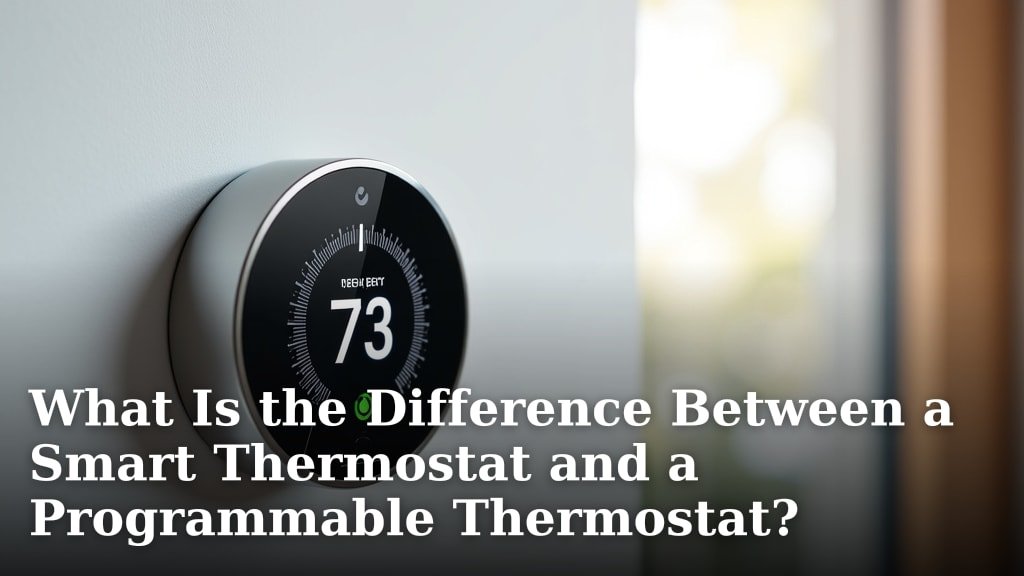
The main difference between a smart thermostat and a programmable thermostat is their level of intelligence and connectivity. A smart thermostat offers remote control and learns your preferences. A programmable thermostat lets you set schedules but lacks advanced features.
Both types help you manage your home’s temperature and save on energy bills. But, a smart thermostat connects to Wi-Fi and often works with other smart home devices. Programmable models are more basic, providing a fixed schedule you input manually. Choosing the right one depends on your needs and tech comfort.
- Smart thermostats learn your habits.
- Programmable thermostats use fixed schedules.
- Smart thermostats connect to Wi-Fi for remote control.
- Programmable thermostats offer basic scheduling.
- Both can help save energy.
Ready to find out which thermostat is best for your home? Let’s explore the details of each option.
Understanding Smart vs. Programmable Thermostats
Let’s really get into what sets these two thermostat types apart. It boils down to how they interact with your home and your lifestyle. Think of it like comparing an old flip phone to a modern smartphone. Both make calls, but one does so much more!
You’re looking for comfort and savings, right? We’ll help you see which device can deliver those benefits most effectively for your unique situation.
Programmable Thermostats: Your Basic Scheduler
A programmable thermostat is a straightforward device. It lets you set a schedule for your heating and cooling. This schedule repeats automatically each week.
You tell it exactly when to turn on or off. For example, you might set it cooler at night. Then, it warms up before you wake in the morning. It’s a great step up from a manual thermostat.
How Programmable Thermostats Work
These devices operate on a pre-programmed schedule. You typically use buttons on the unit to set times and temperatures. It’s a “set it and forget it” approach, but with a fixed schedule.
You can often have different settings for weekdays and weekends. Some even allow for different settings for each day of the week. This offers a good level of control without being too complicated.
Benefits of Programmable Thermostats
- Energy Savings: You can reduce energy use by turning down the heat or AC when you’re away or asleep. Many homeowners save a fair amount with careful scheduling (Department of Energy).
- Simplicity: They are generally easy to install and use. There’s no Wi-Fi setup or apps to worry about.
- Cost-Effective: Programmable models are usually much less expensive than smart thermostats upfront.
Limitations of Programmable Thermostats
The main drawback is their lack of flexibility. What if your schedule changes unexpectedly? Perhaps you come home early from work. The house might be cold or hot until the next scheduled change.
They also can’t adapt to changing weather conditions on their own. You have to manually override the schedule if there’s a sudden cold snap. This can sometimes lead to wasted energy if you forget to adjust it back.
Smart Thermostats: Your Intelligent Home Assistant
Now, let’s talk about smart thermostats. These devices take comfort and savings to the next level. They aren’t just about schedules; they’re about learning and adapting.
Imagine a thermostat that knows when you’re home. Or one that can adjust based on the outside temperature. That’s the world of smart thermostats.
How Smart Thermostats Work
Smart thermostats connect to your home’s Wi-Fi network. This connection is key. It allows for remote control via your smartphone, tablet, or computer.
Many models also include sensors. These can detect if you’re home or if a window is open. They use this data to make smart adjustments.
Key Features of Smart Thermostats
- Remote Access: Adjust your home’s temperature from anywhere. Heading home early? Turn on the AC before you arrive. Forgot to turn it off? Do it from work!
- Learning Capabilities: Some smart thermostats learn your preferences over time. They observe when you adjust the temperature and create an optimized schedule for you.
- Geofencing: This feature uses your phone’s location. When you leave a set perimeter, it lowers the temperature. When you head home, it starts warming or cooling your house.
- Energy Reporting: Many provide detailed reports on your energy usage. This helps you understand where you can save more.
- Voice Control: Integrate with smart home assistants like Amazon Alexa or Google Assistant. “Hey Google, set the thermostat to 72 degrees.”
- Weather Adaptation: They can check local weather forecasts. Then, they adjust your settings to prepare for upcoming temperature changes. This helps maintain comfort and efficiency.
Benefits of Smart Thermostats
The biggest benefit is often greater energy savings. Because they adapt and learn, they can be more efficient than a fixed schedule (Environmental Protection Agency). You also get unparalleled convenience and control.
For example, if your morning routine changes, a smart thermostat can adapt. A programmable one would just stick to the old schedule. This makes your home more comfortable without you lifting a finger.
Limitations of Smart Thermostats
They usually have a higher upfront cost. Installation can also be more complex if you’re not tech-savvy. You might need to check your wiring, especially for older homes.
Also, they rely on a stable Wi-Fi connection. If your internet goes down, you might lose some smart features. You can still operate them manually, though.
Comparing Your Options: Which is Right for You?
Now that you know the ins and outs, how do you decide? It really comes down to your personal needs and how much control you want.
Are you someone who loves gadgets and connecting everything? Or do you prefer a simpler, hands-off approach?
Factors to Consider
- Budget: How much are you willing to spend initially? Programmable thermostats are budget-friendly.
- Tech Comfort: Are you comfortable with apps, Wi-Fi setup, and smart home integration?
- Schedule Consistency: Is your daily routine very predictable? A programmable thermostat might suffice. If your schedule varies, a smart thermostat is a better fit.
- Desire for Remote Control: Do you often wish you could adjust your home’s temperature when you’re not there?
- Energy Savings Goals: Are you looking to maximize energy efficiency through advanced features?
Quick Comparison Table
| Feature | Programmable Thermostat | Smart Thermostat |
|---|---|---|
| Connectivity | No Wi-Fi | Wi-Fi enabled |
| Control Method | On-device buttons | App, voice, on-device |
| Learning Ability | None | Yes (many models) |
| Remote Access | No | Yes |
| Geofencing | No | Yes (many models) |
| Energy Reporting | Basic/None | Detailed (many models) |
| Cost (Upfront) | Lower | Higher |
| Installation | Simpler | Potentially more complex |
Making Your Decision: A Quick Checklist
Let’s make this easy for you. Ask yourself these questions to pinpoint your ideal choice:
- Do you want to control your thermostat from your phone, even when you’re not home?
- Is your daily routine unpredictable, making a fixed schedule difficult?
- Are you keen on getting detailed reports about your energy consumption?
- Do you have other smart home devices you’d like to connect to your thermostat?
- Are you comfortable with a slightly higher initial investment for long-term benefits?
If you answered “yes” to most of these questions, a smart thermostat is likely your best bet. If you prefer simplicity, a lower upfront cost, and have a very consistent schedule, a programmable thermostat will serve you well.
Conclusion
Choosing between a smart and a programmable thermostat comes down to your lifestyle and comfort with technology. A programmable thermostat offers solid energy savings with its fixed schedule, perfect if your daily routine is consistent. It’s a simple, cost-effective choice.
On the other hand, a smart thermostat offers advanced features like remote control, learning capabilities, and geofencing. While it costs more upfront, you gain unmatched convenience and potentially greater energy savings. Consider your budget, tech comfort, and daily schedule to pick the best fit for your home.
Frequently Asked Questions
Can a programmable thermostat save as much energy as a smart thermostat?
A programmable thermostat can save a significant amount of energy if you consistently use its scheduling features. However, smart thermostats often offer more savings through adaptive learning, remote adjustments, and features like geofencing that prevent heating or cooling an empty home.
Do I need a C-wire for a smart thermostat?
Many smart thermostats require a C-wire (common wire) for continuous power. This is because they need more consistent power than older thermostats. Some models offer workarounds, but checking for a C-wire or an adapter is a good first step if you’re considering a smart thermostat.
What if my Wi-Fi goes out with a smart thermostat?
If your home Wi-Fi goes out, most smart thermostats will still function as a basic programmable thermostat. You can typically adjust the temperature directly on the unit. However, you will lose remote control, learning features, and connectivity with other smart home devices until your Wi-Fi is restored.
Are smart thermostats compatible with all HVAC systems?
Most smart thermostats are designed to be compatible with common HVAC systems, including conventional and heat pump systems. However, some advanced or older systems might have specific wiring requirements. Always check the compatibility list provided by the thermostat manufacturer before purchasing.
Is professional installation necessary for smart thermostats?
While many smart thermostats are designed for DIY installation, professional installation can be beneficial. An HVAC technician ensures proper wiring, especially if you lack a C-wire, and can help optimize settings for your specific system. This ensures maximum efficiency and avoids potential installation errors.
