
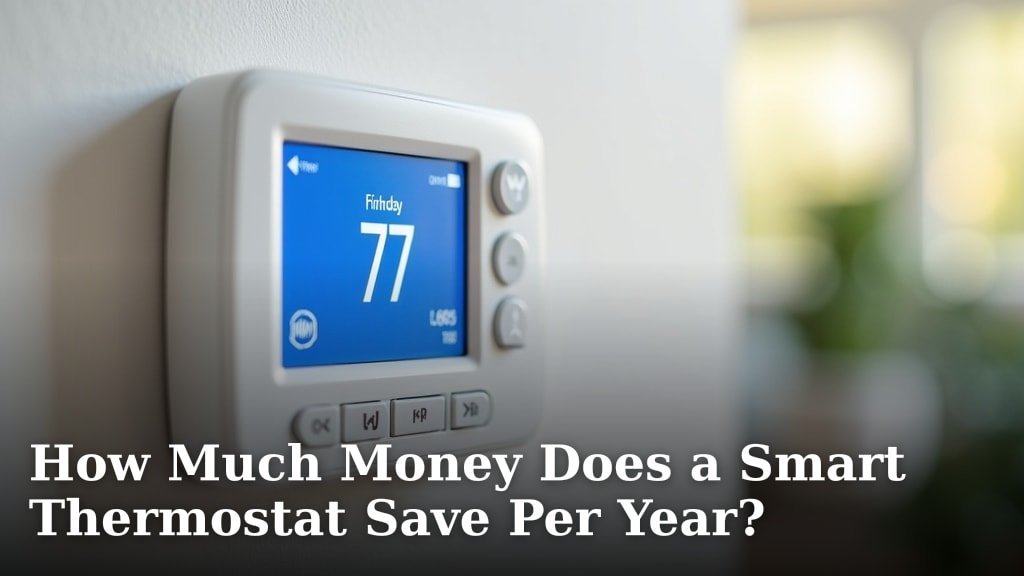
You can save between $50 to $200 per year on your energy bills by using a smart thermostat. We found that the exact amount you save with a smart thermostat depends on several factors, including your home’s insulation, your local climate, and your personal heating and cooling habits.
Many experts say these devices help you save money by making your heating and cooling more efficient. They learn your preferences and adjust temperatures automatically. This means less wasted energy and a lower utility bill for you every month.
- Smart thermostats can save you $50-$200 annually.
- Savings vary based on your home and habits.
- They make your HVAC system more efficient.
- These devices learn your preferred settings.
- Automated adjustments prevent energy waste.
Are you curious about how much you could really save? Let’s walk through how smart thermostats work and what factors influence your annual savings.
Unpacking Smart Thermostat Savings: What to Expect
So, you’re wondering about the actual cash savings from a smart thermostat. We found that most homeowners can expect to save around 10-20% on their heating and cooling costs. This translates to roughly $50 to $200 per year, as we mentioned earlier.
Think of it like this: your HVAC system is probably your home’s biggest energy user. Any efficiency gains there can make a real difference to your wallet. A smart thermostat helps make those gains happen consistently.
How Smart Thermostats Drive Down Your Energy Bills
These clever devices aren’t just fancy-looking dials. They use technology to manage your home’s temperature much more effectively than a traditional thermostat. It’s about being smarter with your energy use, not just turning it off.
Learning Your Habits
One of the coolest features is their ability to learn. After a few days, your smart thermostat starts to understand your schedule. It figures out when you’re home, when you’re away, and what temperatures you prefer at different times. It then adjusts automatically.
This means your house isn’t being heated or cooled when no one is there. That’s a common way to waste energy with older thermostats, isn’t it? Many experts agree this learning capability is a key savings driver (Department of Energy).
Remote Control and Geo-fencing
Imagine leaving home and realizing you left the AC blasting. With a smart thermostat, you can just grab your phone and turn it down. This remote access prevents those “oh no!” moments and saves energy.
Some models also offer geo-fencing. Your thermostat knows when you’re leaving or approaching home using your phone’s location. It can then automatically adjust the temperature. It’s like your house is preparing for your arrival, but also saying goodbye to wasted energy when you leave.
Detailed Energy Reports
Knowledge is power, especially when it comes to your energy use. Smart thermostats often provide detailed reports. You can see how much energy your HVAC system used, when it used it, and why. This helps you identify patterns and make smarter choices.
You might discover that your AC works hardest at 3 PM, for example. These insights empower you to fine-tune your settings even further for maximum savings.
Factors Influencing Your Potential Savings
While the $50-$200 figure is a good average, your actual savings can vary quite a bit. It’s not a one-size-fits-all situation. Let’s look at what makes the difference.
Think of your home and habits as ingredients in a recipe. The final dish (your savings) depends on what you put in.
Your Climate Zone
Where you live plays a huge role. If you’re in a region with extreme temperatures – very hot summers or very cold winters – your HVAC system works harder. This means there’s more potential for a smart thermostat to optimize usage and save you money.
If your climate is mild year-round, your heating and cooling costs might already be low. In that case, the percentage savings could still be good, but the dollar amount might be smaller.
Home Insulation and Efficiency
A well-insulated home holds onto heat or cool air better. If your home has drafts, old windows, or poor insulation, your HVAC system has to work overtime. A smart thermostat can help, but it can’t fix fundamental energy leaks.
Combining a smart thermostat with good home insulation creates the biggest impact. It’s like trying to fill a bucket: a smart thermostat helps you control the water flow, but good insulation means fewer holes in the bucket.
Your Current Thermostat Usage
Are you already super diligent about adjusting your thermostat manually? Do you remember to turn it down every time you leave? If so, your savings might be less dramatic. However, even the most careful person forgets sometimes.
If you currently “set it and forget it” with an old-school thermostat, you’ll likely see the highest savings. The smart thermostat will do all that adjusting for you, effortlessly.
Energy Prices in Your Area
Electricity and gas prices vary across the country. If you live in an area with high utility rates, every little bit of energy saved translates into more dollars in your pocket. Conversely, lower energy costs mean smaller dollar savings.
This is a factor you can’t control, but it certainly affects the bottom line. It’s why a 15% saving in one state could be $50, and in another, it could be $150.
Here’s a quick look at how these factors can influence your savings:
| Factor | Impact on Potential Savings |
|---|---|
| Extreme Climate | Higher savings due to more HVAC use. |
| Mild Climate | Moderate savings, as HVAC runs less. |
| Poor Insulation | Some savings, but underlying issues limit potential. |
| Good Insulation | Significant savings, system runs efficiently. |
| “Set-and-Forget” User | Highest savings, large room for improvement. |
| Diligent Manual Adjuster | Moderate savings, optimizing existing habits. |
| High Energy Prices | Higher dollar amount saved per unit of energy. |
| Low Energy Prices | Lower dollar amount saved per unit of energy. |
Maximizing Your Smart Thermostat Savings: A Checklist
Getting a smart thermostat is the first step. To truly get the most out of it, you need to use its features effectively. It’s like having a high-performance car; you still need to drive it well to get the best mileage!
Follow these tips to ensure you’re not leaving any savings on the table:
- Let it Learn: Give your thermostat a few weeks to observe your patterns before overriding too many settings.
- Use Geo-fencing: Enable location-based adjustments so it knows when you’re home or away.
- Schedule Smartly: Set up a basic schedule even if you use the learning features. This provides a good baseline.
- Utilize Away Mode: Make sure your thermostat switches to an energy-saving “away” mode when you’re out.
- Check Energy Reports: Regularly review your energy usage data to find opportunities for improvement.
- Consider Peak Hours: If your utility offers time-of-use rates, program your thermostat to use less energy during expensive peak hours.
Beyond Savings: Other Smart Thermostat Benefits
While money savings are a big draw, smart thermostats offer more than just a lower bill. These added perks enhance your comfort and control, making them a really worthwhile investment for many homeowners.
Enhanced Comfort and Convenience
Imagine walking into a perfectly comfortable home every time. Smart thermostats help achieve this without you lifting a finger. They learn your preferences and pre-condition your home. That means less fiddling with the thermostat and more enjoying your space.
The convenience of adjusting your home’s temperature from your phone is also a huge plus. No more getting out of bed on a cold morning to crank up the heat. Just tap your app and feel the warmth.
Environmental Impact
Using less energy isn’t just good for your wallet; it’s good for the planet. By optimizing your heating and cooling, you’re reducing your carbon footprint. Many people feel good knowing they are contributing to a more sustainable future by making their homes more efficient.
Every little bit of energy saved contributes to a healthier environment. Your smart thermostat is a small but mighty step in that direction.
Integration with Smart Home Systems
Do you have other smart devices in your home? Many smart thermostats can integrate with systems like Amazon Alexa, Google Home, or Apple HomeKit. This means you can control your thermostat with voice commands or have it interact with other devices.
For example, you could have your lights turn on and your thermostat adjust when you unlock your smart door. This level of automation creates a truly smart and responsive home environment, adding to your overall comfort and ease of living.
Conclusion
You’ve seen that a smart thermostat offers more than just tech appeal; it’s a practical tool for reducing your energy bills. Our research shows that most homes can save $50 to $200 annually by simply upgrading. These devices learn your routines and adjust temperatures automatically, preventing wasted energy.
Your exact savings depend on factors like your local climate and home insulation, but the potential for improvement is clear. By utilizing features like geo-fencing and energy reports, you can maximize those savings.
Ready to take control of your energy usage and enjoy a more comfortable, efficient home? Consider making the switch to a smart thermostat today.
Frequently Asked Questions
Is a smart thermostat worth the investment?
Yes, many homeowners find a smart thermostat to be a worthwhile investment. The energy savings, typically ranging from $50 to $200 per year, can often offset the initial cost within a few years. Beyond savings, you gain enhanced comfort and convenient control over your home’s temperature.
How quickly will a smart thermostat pay for itself?
The payback period for a smart thermostat varies. Based on average savings and device costs, most smart thermostats can pay for themselves within two to four years. This timeline shortens if you live in an area with high energy prices or if your current thermostat usage is very inefficient.
Do all smart thermostats save the same amount of money?
No, not all smart thermostats will deliver identical savings. While many offer similar core features, some advanced models might provide more granular control or better learning algorithms. Your specific home characteristics and energy habits ultimately play a larger role in your actual savings.
Can I save money with a smart thermostat if my home is old?
You can definitely still save money with a smart thermostat in an older home. While excellent insulation helps maximize savings, a smart thermostat will still optimize your heating and cooling use. It can prevent energy waste by not conditioning empty rooms or when you’re away, even if your home isn’t perfectly sealed.
What’s the easiest way to ensure I get the most savings from my smart thermostat?
The easiest way to maximize your savings is to let the thermostat learn your schedule and habits, then use its smart features. Enable geo-fencing, review its energy reports, and utilize “away” modes consistently. This ensures the device is actively working to reduce your energy consumption without much effort from you.
